


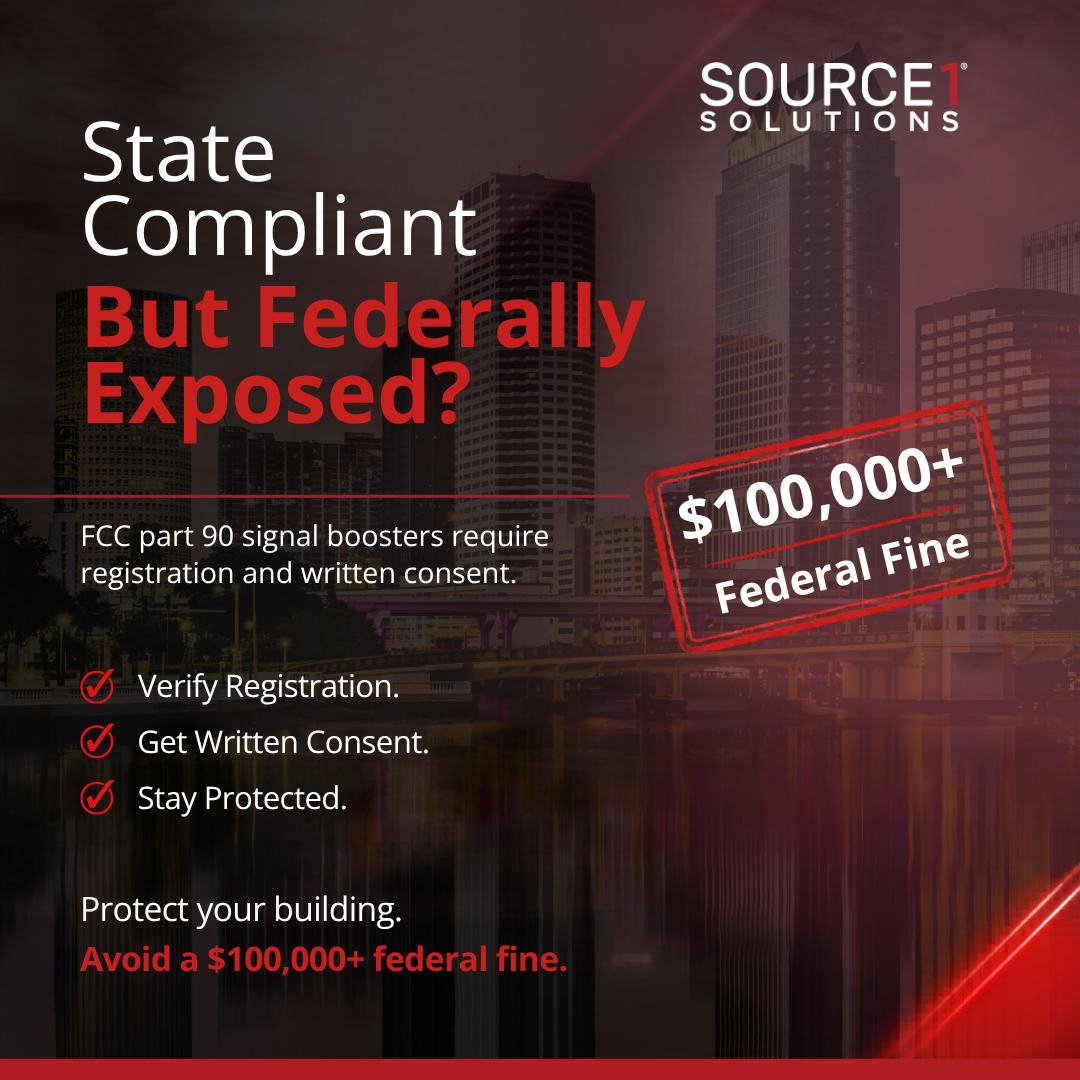
Florida building owners working through ERCES compliance typically focus on the state and local enforcement layer: AHJ citations, Chapter 162 fines, certificate-of-occupancy gating. That layer is real and material. It is also not the largest enforcement exposure attached to an in-building radio coverage system. FCC signal booster registration sits in a parallel federal track that most building owners, and even some integrators, overlook until an enforcement action lands.
The FCC Part 90 signal booster regulations add a second dimension of risk that sophisticated owners, general contractors, and life-safety consultants increasingly pay to avoid. Understanding both layers is the difference between an ERCES system that passes the AHJ and an ERCES system that survives a federal inspection. This article walks through what Part 90 requires, why FCC signal booster registration matters separately from state code, and the three verification steps that determine whether a building’s system is exposed.
What FCC Part 90 Actually Requires for Signal Boosters
The FCC regulation governing Part 90 signal boosters is explicit on four points. Public safety signal boosters, which includes the bidirectional amplifier (BDA) systems used in ERCES installations, are not consumer devices. They require an FCC license or express consent of an FCC licensee. Class B booster registration with the FCC is mandatory. Unauthorized use may result in forfeiture penalties in excess of $100,000 per continuing violation.
The FCC also provides a registration and discovery tool for Part 90 Class B signal boosters. The tool exists to support the practical reality that frequency licensees and regulators can identify which boosters are registered in a given market. By implication, they can also identify which are not. The tool is the federal-side equivalent of the state-side AHJ inspection: a mechanism for identifying noncompliant systems already in the field.
Why FCC Signal Booster Registration Matters Separately From State Code
An ERCES system fully compliant with Florida state requirements but lacking proper FCC registration or licensee consent creates a dual-exposure problem. The building owner faces enforcement on two independent tracks. State-level enforcement under Chapter 162 if the system does not meet local AHJ technical requirements. Federal enforcement under FCC Part 90 if the system operates without proper registration or licensee consent. Compliance with one track does not ensure compliance with the other.
This is the single most common compliance gap in the existing Florida ERCES installed base. Buildings built before the federal enforcement environment tightened often have functional, AHJ-approved systems with no federal documentation behind them. The system works. The state inspection passed. The FCC registration was never filed, the written licensee consent was never obtained, and nobody has revisited the question since activation.
The Licensee Consent Requirement
Across Florida, multiple county guidance documents reinforce the requirement for written authorization from the frequency license holder before system activation. Orange County’s Fire Rescue contractor checklist emphasizes written authorization from the frequency license holder prior to activation, citing NFPA 1225. Brevard County’s integrator requirements mandate approval by both the local AHJ and the frequency license holder before any work begins. Pinellas County’s Radio and Technology guidance ties system activation to provisional retransmission authorization from the county radio office.
The license holder is typically the county sheriff’s office or the county’s public safety communications division. Without their documented written consent, the BDA system is operating on frequencies it is not authorized to amplify. A verbal approval, a casual email, or a coordination meeting without a signed authorization document does not satisfy the federal requirement. The FCC expects a paper trail.
The Interference Risk Behind the Enforcement Posture
The FCC’s enforcement posture on unauthorized signal boosters is driven by a practical concern: radio frequency interference. An improperly designed, installed, or registered BDA system can interfere with public safety communications on adjacent frequencies or in adjacent geographic areas. In a life-safety context, interference with first responder radio traffic is not a technical nuisance. It is a direct threat to emergency response in the very building the system was installed to protect.
That is why experienced ERCES integrators treat FCC signal booster registration and licensee coordination as core deliverables, not administrative afterthoughts. The integrator who handles complete federal compliance documentation protects the building owner from an enforcement exposure that dwarfs the state-level fine structure. The integrator who skips it transfers that exposure to the owner without telling them.
Three Verification Steps Every Building Owner Should Run Now
For any building owner with an existing ERCES or BDA system, three questions determine federal compliance exposure. The answers should be available in under five minutes. If they are not, that is the finding.
First. Is the BDA system registered as a Class B booster with the FCC? The registration documentation should name the building, the system, the frequencies in scope, and the registered party. If no documentation can be produced, the system may be operating unauthorized and is identifiable through the FCC discovery tool.
Second. Is there documented written consent from the frequency license holder? Not verbal approval. Not an email from a contact at the agency. Written authorization that can be produced for an FCC inspection or a county audit. The consent should reference the specific frequencies the BDA amplifies and the specific physical scope of the installation.
Third. Was the integrator who designed and installed the system aware of, and compliant with, Part 90 requirements? If the integrator did not handle FCC registration and licensee coordination as part of the project deliverables, those steps may not have been completed. State ERCES experience does not imply federal Part 90 fluency.
The Cost Asymmetry
State-level Chapter 162 fines max out in the thousands of dollars per day. FCC forfeiture penalties for unauthorized signal booster operation start at $100,000 per continuing violation. The federal exposure is an order of magnitude larger than the state exposure, and the federal enforcement environment is tightening rather than relaxing.
For building owners, the math is straightforward. The cost of engaging a qualified, compliance-first integrator who handles both state and federal requirements is a rounding error compared to the cost of a single FCC enforcement action. The same calculation applies in reverse: the savings from skipping federal coordination on the original install evaporate the moment the FCC opens a file.
Closing the Gap
For any owner with an existing ERCES or BDA installation, the right move is a federal compliance check before the next AHJ cycle, not after a regulator surfaces. Confirm the FCC Class B booster registration, locate the written licensee consent, and verify the integrator’s Part 90 documentation. If any of the three is missing, remediation is straightforward; an unaddressed federal exposure is not.
Check a building’s complete compliance status, including federal FCC signal booster registration alongside state ERCES requirements, with the Source 1 Solutions.