
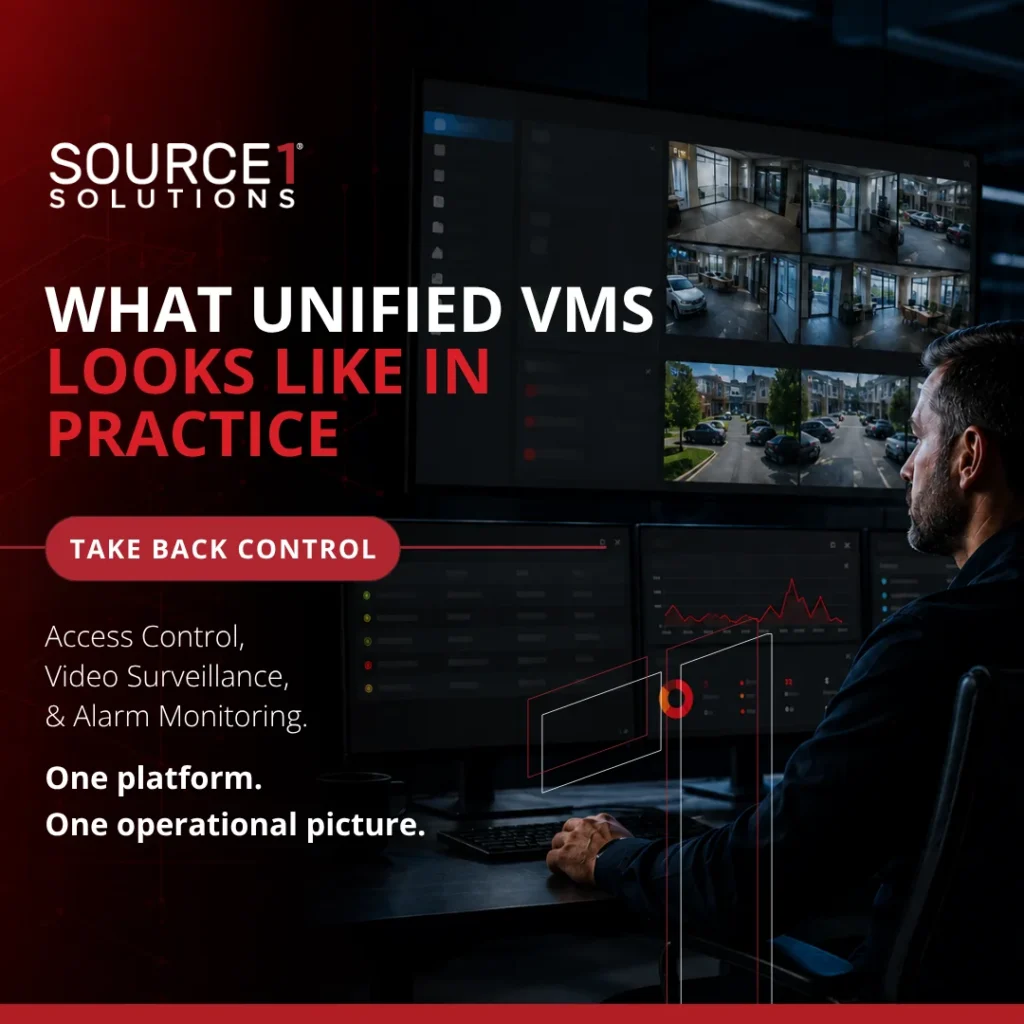
A unified VMS is no longer an architectural preference. It is the operating model the security industry has converged on. More than 70% of organizations now run on unified physical security platforms, according to industry research, and 60% cite integration capability as the primary reason they upgraded their security technology stack. These are not aspirational numbers. They reflect a decisive market shift away from siloed access control, video management, and alarm systems and toward platforms designed to consolidate the operational picture into one application.
Genetec Security Center is one of the leading platforms enabling that consolidation. Understanding what a unified VMS delivers in practice, rather than what the platform brochure claims, matters for any organization evaluating its security technology roadmap, its incident response posture, or its convergence between physical security and IT. This article walks through what unification actually means at the architecture level, what it changes in the security operations center, what to evaluate in a platform decision, and where the operational ROI shows up.
What “Unified” Actually Means at the Architecture Level
The word “unified” is overused in security technology marketing. Every platform claims integration. The real distinction sits at the architecture layer: platforms that bolt together separately developed modules with middleware versus platforms designed from inception as a single system with a shared data model. The two look similar on a feature comparison. They behave very differently under operational load.
A genuinely unified VMS provides a single management interface where operators handle access control, video, alarms, intercoms, and intrusion detection from one application. During an incident, there is no switching between consoles, no separate logins, no waiting for one system to surface what another already knows. The operator sees the badge read, the camera feed, and the alarm event correlated in a single timeline.
It also provides one data model. Events from different subsystems, whether access granted, video motion detected, or alarm triggered, sit in a single database with consistent schemas. Reporting, analytics, and forensic investigations query one data source rather than reconciling exports from three. Centralized device management follows from the same architecture: firmware updates, health monitoring, configuration, and diagnostics apply across the entire connected fleet from one console, and cameras, access panels, and intrusion sensors all appear as one managed inventory rather than three.
Unified credential management is the fourth pillar. One cardholder record governs both physical access (badge, mobile credential, PIN) and video-verified access. When an employee is offboarded, one action revokes credentials everywhere, eliminating the orphan-credential problem that drives a significant share of insider-risk incidents in multi-system environments.
Where Unified VMS Changes the SOC
The practical advantage of a unified VMS is not convenience. It is the speed and accuracy of the operational response in the moments that matter most. Consider an access control alarm at a secured door. In a non-unified environment, the operator first sees the alarm on the access control console. They then switch to the VMS to pull the corresponding camera feed. They then check the cardholder database to identify who badged at that door. Each step takes seconds. Each step requires navigating between systems, with friction that compounds during real incidents when the operator is already working under pressure.
In a unified environment, the same alarm triggers a correlated view. The door event, the associated camera feed, and the cardholder record surface simultaneously, with timestamps aligned and the operator’s full attention free to assess the situation rather than chase its components. Time from alert to situational awareness compresses from minutes to seconds. Across a portfolio of dozens or hundreds of doors, that compression is operationally significant. It is also measurable, which is why mature SOC operations track time-to-context as a unified VMS adoption KPI.
What This Means for Distributed Organizations
Distributed organizations, those managing multiple sites under one security operations function, face structural challenges that a unified VMS is purpose-built to solve. County governments managing dozens of buildings, school districts managing hundreds of facilities, multi-campus healthcare systems, retail chains, and large manufacturers all share the same problem: the security policy is supposed to be consistent across sites, but every site has historically run on its own stack.
A unified platform delivers centralized visibility across all facilities from a single command center. An operator at a regional SOC can monitor doors, cameras, and alarms at every site in scope without a separate system login for each. Access policies, video retention schedules, and alarm response procedures are configured once and applied across the fleet, eliminating the site-level variation that creates most of the security gaps in distributed environments. Compliance reporting, the perennial pain point for multi-site security, produces consistent output from one data model, eliminating the report reconciliation problem.
How to Evaluate a Unified VMS Platform
For organizations considering a move to a unified platform, the decision is not just a technology selection. It is an operational change management exercise that requires a clear-eyed evaluation across several axes.
Existing infrastructure compatibility comes first. Can the unified VMS incorporate existing cameras, access controllers, and sensors, or does unification require a forklift hardware replacement? The total cost of ownership has to account for both the platform license and the transition path. A platform that requires complete hardware replacement may be the right call long term, but the conversation has to be honest about the migration cost.
Integration depth comes second. Not all unification is equal. The depth of integration between access control, video, and alarm management varies considerably by platform, and the variance only surfaces during real operational workflows. Evaluators should test actual incident response scenarios on the demo system, not feature checklists. The platform that wins the spec sheet does not always win the SOC.
Staff training is the third evaluation axis. Operators accustomed to separate systems need structured training on the unified interface, and time-from-deployment to operational proficiency is a critical planning factor. The fastest unified VMS rollouts are paired with structured operator training and SOP rewrites. The slowest ones treat training as an afterthought and pay for it in incident response time for the first six months.
Where the Operational ROI Actually Shows Up
The ROI of a unified VMS shows up in three places. First, in mean time to context: the seconds between alert and operator awareness, which directly correlates with incident severity outcomes. Second, in audit and compliance reporting: a single data model produces faster, cleaner, defensible reports across all sites, which materially reduces the load on compliance teams. Third, in credential governance: one cardholder record across access control and video-verified access closes the offboarding gap that drives a meaningful share of insider-risk incidents.
Across an enterprise security program, those three areas typically deliver the ROI that justifies the platform investment within the first 18 to 24 months. The harder benefits, the operational culture changes that come from running one system instead of three, take longer to surface but are often the ones that change how the SOC actually performs.
Closing the Evaluation Gap
For any organization assessing whether a unified VMS belongs on the technology roadmap, the right starting point is an honest read on current state: what is integrated today, what is not, and what the operational picture looks like during an actual incident. The Source 1 Solutions Convergence Maturity Assessment evaluates current technology, governance, and operational integration posture across those dimensions.