
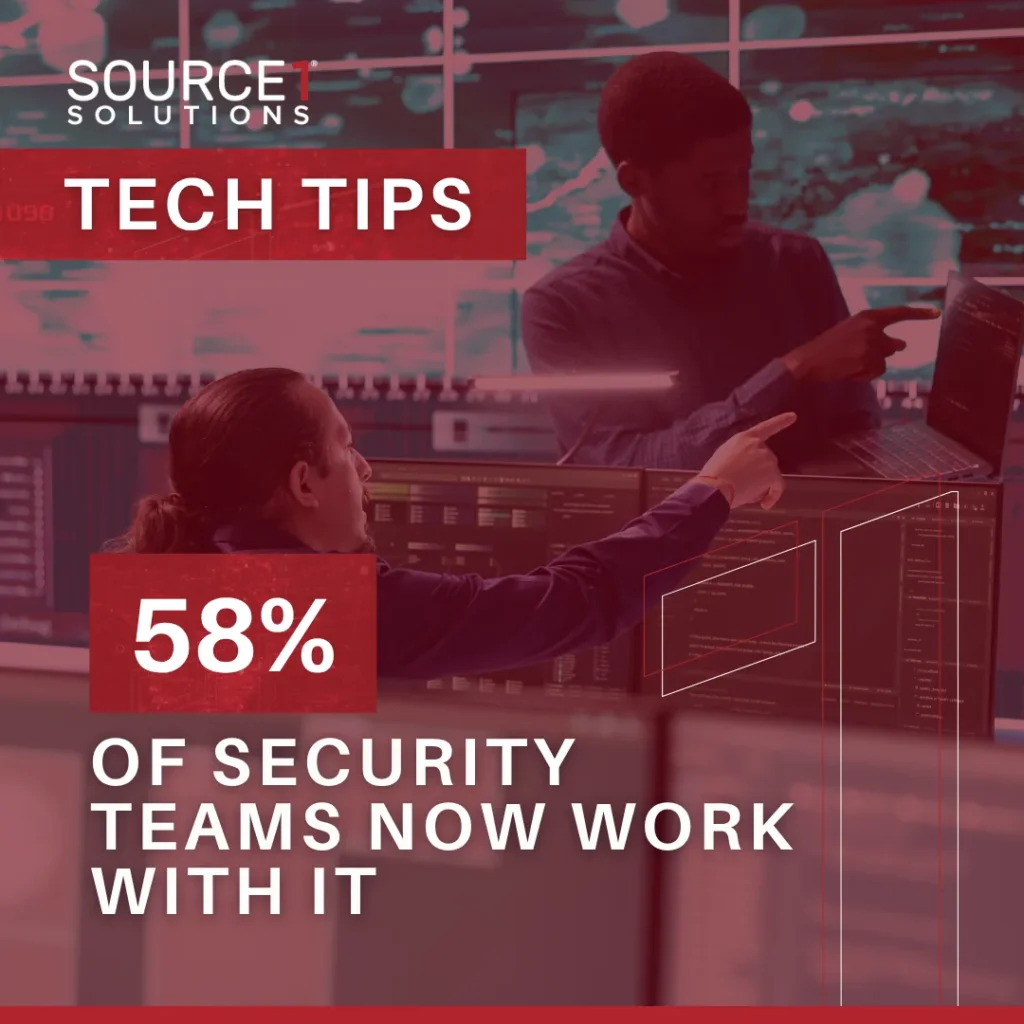
The data is no longer ambiguous. According to the HID/IFSEC Global Report on Physical Security Trends, 58% of security teams now operate in joint practice with IT departments. Only 24% report little or no overlap between the two functions.
Physical security is already on your network. Every door controller, camera, and access panel is an IP-addressable asset. That means it carries the same risk profile as any other endpoint and should be governed accordingly.
The organizations getting this right aren’t talking about “integration.” They’ve already aligned ownership. Physical security systems are patched, monitored, and managed under IT discipline. Credentials are centralized. Risk is shared and clearly assigned.
The ones getting it wrong are still operating in silos. Separate teams. Separate tools. Separate accountability. That model doesn’t just create inefficiency; it creates exposure.
For facilities leaders, security directors, and IT executives across Florida, this shift is operational, not theoretical. It changes procurement standards, patching responsibility, and incident response.
What Security Integration Looks Like across the USA
Convergence is not putting cameras and door controllers on the network. That happened years ago.
Convergence is operating physical security with the same discipline as IT infrastructure.
In a converged environment, every physical security device is treated as a managed endpoint, not a standalone system.
That means:
- Access control panels, cameras, and sensors are patched on a defined schedule
- Configurations are documented, controlled, and auditable
- Network traffic is monitored and segmented
- Credentials are centralized within enterprise identity systems — not scattered across siloed databases
This isn’t integration. This is governance.
It represents a complete shift from the legacy model, where physical security lived under facilities with minimal IT oversight. That model worked when systems were closed, proprietary, and isolated.
It does not work in an environment where every device has an IP address, a firmware stack, and a potential exploit path.
If it’s on your network, it’s part of your attack surface. And if it’s part of your attack surface, it belongs under IT control.
Why Siloed Access Control and IT Security Increase Risk
The risk of maintaining separate physical security and IT operations compounds over time. When physical security systems operate outside IT governance, several problems emerge:
Vulnerability Management Gaps
Access control panels and video management servers run operating systems and firmware that require patching. If IT doesn’t know these devices exist on the network, or doesn’t have authority to patch them, they become persistent vulnerabilities.
Credential Sprawl
When physical access credentials (badge numbers, PINs, mobile identities) are managed in a separate system from logical access credentials (network logins, application access), there is no unified view of who has access to what. Offboarding becomes unreliable; an employee’s network access may be revoked while their badge continues to open doors.
Incident Response Fragmentation
When a security incident involves both physical and digital dimensions, an unauthorized person accessing a server room, for example, two separate teams with separate tools, separate timelines, and separate reporting structures must coordinate a response. That coordination delay is where incidents escalate.
How to Build a Security Integration Roadmap
Organizations that are serious about convergence typically address it in three phases:
Phase 1: Visibility
Inventory all physical security devices on the network. Document their firmware versions, patch status, network segmentation, and credential management method. This is the baseline assessment that most organizations skip.
Phase 2: Governance Alignment
Establish shared policies for patching, configuration management, credential lifecycle, and incident response that cover both IT and physical security assets. Define clear ownership: who is responsible for what, and what the escalation path looks like when the two domains intersect.
Phase 3: Operational Integration
Implement unified monitoring, shared dashboards, and joint review cadences. This doesn’t mean merging teams, it means ensuring both teams operate from the same information, the same policies, and the same risk framework.
Security Integration Requirements and Compliance Risks
Public-sector organizations face particular urgency. State term contracts for technology products and services now require alignment with the NIST Cybersecurity Framework. As physical security systems become network-attached IT assets, they fall within the scope of these requirements. County governments, school districts, and municipal agencies that have not inventoried their physical security devices as part of their IT asset management programs may find themselves non-compliant with procurement and regulatory expectations they didn’t realize applied.
If your organization is ready to assess where it stands on the convergence spectrum, our Convergence Maturity Assessment maps your current physical security and IT integration across five operational dimensions.
Source 1 Solutions delivers converged physical-IT security operations for distributed organizations across Florida.